

AR400, AR450 or AR500 plate: how to choose the right grade for your application
Compare AR400, AR450 and AR500 by Brinell hardness, weldability and application. Find the BRINAR® equivalent with stock available in Mexico.
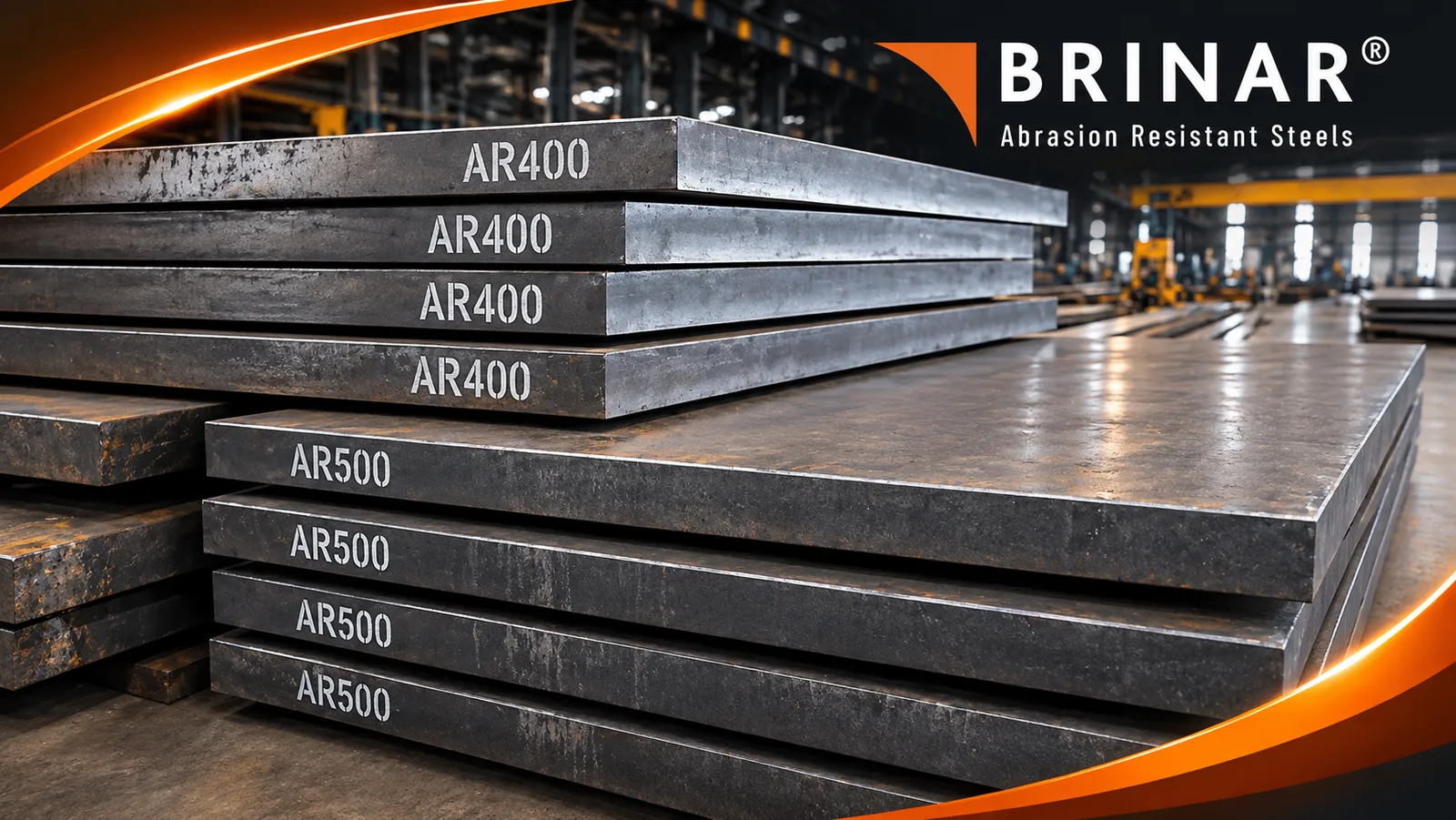
When you look for wear plate, the question is almost always the same: which grade do I need? AR400, AR450 and AR500 are not different brands — they are Brinell hardness levels that define how much the steel can take before it wears out. Choosing wrong means replacing parts too early, or paying more for a grade your application does not need.
In this guide we explain the key differences between the three grades, which applications each one solves and how they relate to the BRINAR® grades available in Mexico.
What do AR400, AR450 and AR500 mean?
AR stands for Abrasion Resistant. The number next to it indicates the nominal hardness on the Brinell scale (HB):
| Grade | Hardness (HB) |
|---|---|
| AR400 | 360 – 440 HB |
| AR450 | 430 – 480 HB |
| AR500 | 460 – 544 HB |
The higher the hardness, the higher the wear resistance — but also the higher the brittleness and the harder it is to weld and cut. The key is finding the right balance for each application.
All three grades are produced through quenching and tempering, which creates a uniform martensitic structure throughout the plate thickness. This sets them apart from surface-treated steels, which wear quickly once they lose their hard outer layer.
AR400: the most versatile and easiest to work
AR400 is the most common grade in industry. It offers enough hardness for most moderate-wear applications, with the advantage of being the easiest of the three to weld, bend and cut.
Typical applications:
- Dump truck bodies and beds
- Aggregate and mineral conveyors
- Feed hoppers and chutes
- Bulldozer and motor grader blades
- Agricultural equipment liners
Wear-resistant steel is typically used in applications such as backhoe buckets, bulldozer blades, dump beds, ore and coal chutes, and aggregate conveyors.
When to choose it: when you need good wear resistance without sacrificing workability. It is the ideal entry point for equipment fabricated in a shop that requires frequent cutting and welding.
AR450: the balance between hardness and toughness
AR450 sits in the middle. It offers more wear resistance than AR400 while keeping enough toughness to withstand moderate impact without fracturing.
Typical applications:
- Jaw and impact crushers
- Mill liners
- Excavator buckets in mining
- Drilling equipment
- High-abrasion components in cement plants
When to choose it: when the equipment combines abrasion with impact — for example, a crusher that receives rock directly. AR450 holds up better than AR400 without reaching the brittleness of AR500.
AR500: maximum hardness for extreme conditions
AR500 is the hardest of the three. It is used when abrasion is severe and wear — not impact — is the dominant factor.
Typical applications:
- SAG and ball mill liners
- Underground mining equipment
- High-speed chutes with very abrasive material
- Applications with high-hardness rock (quartzite, basalt)
When NOT to choose it: in applications with heavy impact or parts with complex geometry that require bending. The harder the steel, the more sensitive it is to impact fractures and the harder it is to work in the shop.
Important note: AR500 is also sold for shooting targets and ballistic applications, but it is not certified for ballistic use in industrial applications. For industrial equipment, the selection criterion is always Brinell hardness and the wear application.
BRINAR® equivalents
BRINAR® is the wear-resistant steel line from Salzgitter AG (Germany), available in Mexico with local stock in Cd. Benito Juárez, N.L. BRINAR® grades correspond directly to AR levels by nominal hardness:
| AR grade (reference) | BRINAR® equivalent | Nominal hardness |
|---|---|---|
| AR400 | BRINAR® 400 | ~400 HB |
| AR450 | BRINAR® 450 | ~450 HB |
| AR500 | BRINAR® 500 | ~500 HB |
The key difference: BRINAR® is manufactured under strict European standards with German certification of origin, which ensures uniform hardness throughout the thickness and full material traceability — something that cannot always be guaranteed with generic AR plate on the market.
How to choose the right grade
Use these three questions as a guide:
- How much abrasion does the application have? — Fine, soft material → AR400. Coarse, hard material (rock, clinker, ore) → AR450 or AR500.
- Is there direct impact? — If the part takes heavy blows (crusher, bucket), prioritize AR400 or AR450 over AR500.
- Do you need to weld or bend the part in the shop? — The higher the grade, the more care the welding process requires (preheating, special electrodes).
If you have questions about which one fits your specific equipment, the BRINAR® team in Mexico can help you define the right grade and thickness for each critical point.
Request your quote with your part specifications and receive a proposal with material in stock, delivered price and technical advice included.
BRINAR® is a registered trademark of Salzgitter AG. Authorized distributor in Mexico: AAMSA.
Need wear-resistant steel for your project?
Quote BRINAR® 400, 450 or 500 with delivery from our warehouse in Monterrey.